Oct 16, 2012

Surrender

Much can be said of Saranagathi. Man surrenders his dignity and status to other men for various purposes in life - wealth, fame, possessions, pomp, power etc. But rarely does he get the chance to surrender to the Lord for the sake of the Lo rd! How can he get the urge so long as he craves for the Aadheya and not the Aadhaara? He longs for the object, but does not long for the base on which the object rests. How long can a baseless object satisfy? He wants the gift, not the giver! - the created not the creator, things from the hand, but not the hand! He is running after a nonexistent thing. Can there be an object without a preexistent cause? No; if there is one, it can only be the uncaused God. It is, therefore, sheer ignorance to surrender individuality for the sake of the transitory products of action, the 'caused' rather than the cause. Surrender rather to the basis, the cause and the origin of all, the Sarveswara. That is genuine Saranagathi. 

There are three types of Saranagathi: Thavaivaaham (I am thine), Mamaiva-thwam (you are mine) and Thwame-vaaham (thou art I). The first affirms, I am yours; the second asserts, you are mine, and the third declares you and I are one, the same. Each is just a step in the rising series and the last is the highest step of all. 

In the first stage, Thav-eva-aham, the Lord is fully free and the devotee is fully bound. It is like the cat and the kitten; the cat shifts the kitten about as it wills; the kitten just mews and accepts whatever happens. This attitude is very gentle and is within easy reach of all. 

In the second, Mama-eva-thwam, the devotee binds the Lord, who is to that extent 'un-free!' Surdas is a good example of this attitude. "Krishna! You may escape from my hold, from the clasp of these arms; but you cannot escape from my heart, where I have bound you," challenged Surdas. The Lord just smiled and assented; for, "I am bound by my devotees," He asserts so without any loss of self-respect. The devotee can tie up the Lord with his Prema; by Bhakthi that overwhelms and overpowers his egoism. When man is full of this type of Bhakthi, the Lord will Himself bless him with everything he needs. His grace will fulfil all his wants. Remind yourself here of the promise made by the Lord in the Geetha. "Yogakshemam vahaamyaham", "I carry the burden of his welfare." 

Next, about the third stage: "Thwamevaaham ithi thridhaa;" this is the Avibhaktha-bhakthi, the inseparable devotion. The devotee offers all to the Lord, including himself, for he feels that he cannot withhold himself. That completes his surrender.

liberation

The Lord replied: "Arjuna! People think that the worship of God with form and attributes is quite enough. This discipline will only be of some help; it will guide the person along the road only for a little while. For the Lord will not cond escend to grant liberation for just this! For he who aims at liberation must first give up attachment to the body. Without that, the Atmic stage cannot be attained. The identification with the body is the expression of ignorance. The Atma must be recognised as distinct from the Prakrithi."

"The craving for objective pleasure which is based on the unreal value attached to Prakrithi has to be removed by Dhyanam and Thapas. When the craving is lost, the individual becomes like the dry nut, inside the coconut shell, which becomes loose and unattached both to the shell and the fibre outside it; it does not germinate or sprout again; it will remain for ever without being spoilt. The individual has no more birth and consequent death. That is to say, he will be liberated. Becoming like that dry nut inside the shell is the stage called Jivan-mukthi, of liberation while alive."

"The contemplation of the Godhead as 'above and beyond all attributes' is necessary for the attainment of Jivan-mukthi. If that is difficult and beyond your capacity, you can do another thing. Dedicate all worship, all adoration all Vedic rituals and other vows and vigils with all the fruits that may accrue, to Me. Take Me as the ultimate goal, as the final aim which transforms all acts into worship; fix your mind on Me, meditate on Me; I shall then shower My grace and take you across the ocean of change, of Samsara; I shall favour you with the goal you seek. Arjuna! It is not an easy task to fix your mind steadily on Me. Not every one can succeed in this. However long the practice, it is hard to keep the mind on Me, without deflecting it towards other things or ideas."

"You might therefore ask, 'Have we no other means?' My reply is, 'Yes; there is'. Even those who are eager to engage themselves in acts that please Me can get established in the Atmic consciousness and gain liberation. By means of prayer, recitation of the name, adoration of the glory, worship, etc., the sins of the past can be destroyed, the inner consciousness purified of impulses and urges; then the light of wisdom will dawn, leading to liberation from darkness."

Jealousy

Jealousy can even come into your relationship with the divinity. 

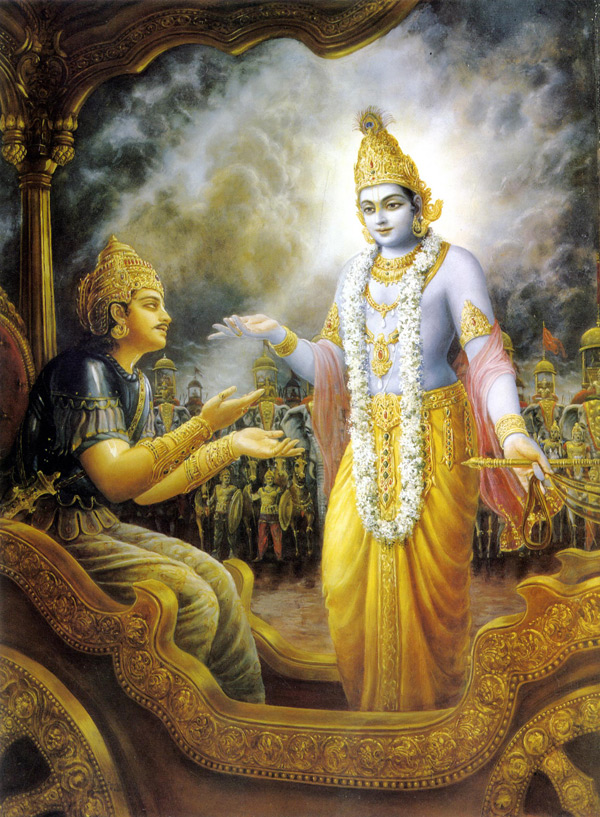
It is a form of arrogance, wherein you think of yourself more than you think of the Lord, and become jealous of the undue attention you feel is being given to the Lord. Ther e is an example of this in the Mahabharata, the great epic detailing the war between the forces of righteousness and evil, in which Arjuna fought on the side of good, and Lord Krishna was his charioteer. 

During that great war, Arjuna was seated in the chariot behind Krishna, who was driving the chariot. On the eve of the war, Arjuna had heard all the teachings explained and expounded by Krishna, which make up the Gita, but he was not yet fully ready to practice them. He felt that Krishna was a very great person, a divine teacher, but he was not able to understand the full divinity of the Lord. 

The great war was going on and some of the most fearsome weapons were being employed on the battlefield. On one particular day, Arjuna was battling with the grandfather, Bhishma, who was the generalissimo of the other side, and was considered one of the greatest warrior of that age. During that fight, a number of very powerful and terrible missiles shot by Bhishma entered Arjuna's chariot, but caused no harm to Arjuna. Arjuna fought brilliantly all day, skillfully wielding his bow while directing the chariot, using his feet to push against Krishna's shoulders, who would then steer the horses, to turn the chariot to the right or left. 

The battle raged unabated with neither side gaining an upper hand until finally towards the end of the day, Bhishma swooned in his chariot and withdrew from the scene. At that point, Arjuna, exhausted but triumphant, blew his conch to proclaim victory in the fight that had been raging that day. Arjuna certainly had faith in the divinity, but at that moment he also felt a little arrogant. In that moment of glory, he felt that he was responsible for the victory and that, after all, Krishna had not fought, but had only driven the chariot. 

It was after sunset when they turned the chariot towards home. As soon as the chariot reached the Pandava camp, Krishna halted it some distance from the tent, turned to Arjuna and said, "Arjuna, please get down and go into the tent." Arjuna who was a little puffed up with egoism thought to himself, 'I fought and won the battle today. Krishna was only the charioteer directed by me. Properly speaking, he should get down first and open the door for me. That would be the correct protocol.' And so Arjuna said to Krishna, "I think you should get down first." But Krishna insisted, "No Arjuna, you get down first." As this interchange continued, Arjuna developed some dark thoughts and began to feel some resentment towards Krishna. 

Arjuna said to himself, 'Here I have been thinking that Krishna was so great, and it is surely because I had complimented him and expressed my admiration for him that he is now acting like this, considering himself more important. Well, it is my own fault. But yet, the war is continuing, it has to be fought and I need Krishna, so it would be best if I didn't develop any strained feelings between us. Getting into an argument with him now would certainly not be in anyone's best interest.' So, very reluctantly, Arjuna got down from the chariot. After he got down he stood near the chariot. Krishna continued pressing Arjuna, "Don't stand here. Go into the tent." Left with no alternative, Arjuna entered the tent. 

Krishna jumped down immediately, leaping a long way from the chariot. The moment Krishna came out, the entire chariot exploded into flames and was destroyed to ashes. 

Arjuna and Dharmaraja, his eldest brother, who were both watching from a distance, were astounded. Arjuna asked Krishna, "What just happened here? What is responsible for this spectacle?" 

Krishna answered, "Arjuna, no one understands my actions. For the divinity there is never any selfishness or egoism. The protection of my devotees is my only concern. The benefit and encouragement of my devotees is my only wish. I kept all those fearsome weapons which were employed by Bhishma and had entered the chariot, harmlessly under my foot. As long as I had my foot on them, they were not able to exercise their powers over you. If I had alighted from the chariot first, these weapons would have destroyed you along with the chariot. You would have been reduced to ashes. Being unaware of this, you asked me to get down first." 

The moment Arjuna heard these words of Krishna, he realized his own arrogant and ignorant behavior. He was exhibiting all the signs of jealousy. Finding fault with the divinity and thinking that he was greater than Krishna can be seen as a form of jealousy. 

There are a number of important signs of jealousy. Jealousy makes its appearance when you meet a person who has earned greater fame than you. Or it will develop when a person has more wealth than you. Jealousy will also show its head when you come into the presence of a person who is more beautiful and handsome. For students, jealousy will soon appear if there is another student who scores higher marks than you. It is the weakness of ordinary human beings to develop jealousy whenever they come in contact with people who excel them in terms of wealth, position, beauty, intelligence, and other such qualities. 

Jealousy will not live harmlessly inside you. The moment jealousy enters all the virtues which you have cultivated over a long time, all the great qualities which you have developed, are destroyed. It ruins the human nature; it strengthens the animal nature; it promotes the demonic nature. It has no scruples. It does not look forward or backward. It is such an insidious quality that you must see to it that jealousy will never possess you. Enjoy the prosperity of others. Enjoy the progress of others. Enjoy the welfare of others. Enjoy the beauty of others. This is true virtue. 

This is one of the most important teachings of the Gita. Desiring the good of others is a laudable quality which everyone should possess.

grief and joy

Arjuna was still doubt-ridden. "O Lord," he began, "You said that the bodily changes are like the stages of wakefulness, dream and sleep. But we do not forget our experiences when we awake from deep sleep. The experiences of previous births are destroyed in memory by the incident called death." 

Krishna replied that it was not possible to recall to memory all experiences, but it was possible to recall some. For the Atma persisted, though the vehicle changed. 

Arjuna then shifted to another point; a point which pesters many besides Arjuna. That is why Krishna says, "Dheerasthathra na muhyathi, the Dheera is not deluded by this." He does not say Arjuna should not be deluded by this. He intends to teach all wavering minds. Krishna solves every doubt as soon as it arises. 

He said, "Arjuna! While passing through the three stages, Buddhi somehow manages to keep some points in its hold. But it too is destroyed when death comes to the body. At one stroke, all is forgotten. Memory is the function of the intellect, not the Atma. "

"Now consider this: You cannot now tell exactly where you were on a definite day, ten years ago, can you? But you existed that day, ten years ago. About that there is no doubt. You dare not deny your existence then. The same is the case of the life before this which you lived, though you have no recollection how and where. The wise man is not deluded by such doubts, nor agitated by them." 

 "The Atma does not die; the body does not stay. Do you think that your grief at their possible death will make the Atma of your opponents happy? That is an insane thought. The Atma does not derive joy or grief whatever happens or does not happen. Let the senses keep to their places; there is no reason to fear. It is only when they start contacts with objects, that the twin distractions, joy and grief, get produced. When you hear some one defaming you, you feel anger and grief; but no such agitation can take place if the words do not fall on your ears. The object-ward movement of the senses is the cause of grief and its twin, joy."

What must we seek from God and why?

When worship is rendered with a view to fulfill desires and realize wishes, the precious prize will be lost. Worship must cleanse the heart, so that God, the Indweller, may shine in all His glory. Know that desires tarnish the heart, instead of cleansing it. Invite a prince, who is yet a child to sit on the throne – he will start weeping, for he cannot play on the throne with his toys and pets. The adults would sneer at the boy’s fondness for toys, they would call it childishness. So too, all those, who keep away from the throne of ‘Sovereignty over themselves’ and prefer to play with the toys and pets of material things are equally childish, no matter what their age or status is!

story - 4types of devotion

There is a little story which illustrates the four types of devotion. 

Once, a wealthy man who had four wives had to go abroad for some important work. He spent a few months in a foreign country. Before he returned home, he wrote a letter to each of his four wives. In the letter he mentioned that he would be coming home in a few weeks, and if there was anything they wanted from that particular c ountry, they could send a list and he would be glad to bring back the various things to them. 

His first wife was an unhappy lady; she was suffering from many ailments. She sent the husband a list of medicines, explaining that her health was not good and that she would like to have a number of foreign medicines which would help her feel better. 

His second wife had a great many desires. She wrote, 'Dear husband, please bring me some fine jewels, some silk saris and all the latest fashionable articles that are available there.' He received her letter and arranged to procure those items for her. 

The third wife had a strong spiritual inclination. She wrote to the husband asking for any good books that were available in that country, books which dealt with the lives of great saints, depicting their life experiences. She was always looking for good spiritual books that would inspire her in her own spiritual aspirations, and so she asked her husband to see if he could find such books and bring them back for her. 

His fourth and favorite wife wrote, 'Dearest one, I do not need anything for myself. I will be very happy when I know that you have come back home, safe and sound.' 

When he returned home he brought with him whatever they had asked for. The first wife got the latest medicines and tonics from abroad. The second wife got beautiful jewels and exquisitely textured silk saris. To the third wife the husband brought the finest copies of the scriptures and other holy books. And then he went to stay with the fourth wife, who had written, 'Please come home safely; I want nothing else.' She only wanted him. 

The other three wives became jealous of the favorite one since the husband had gone to stay with her. They sent messages asking, "After such a long time without seeing us you have not even once come to our houses to visit us. What is the reason for this?" 

The husband replied, "I have given each of you exactly what you asked for. One of you asked for medicines; I brought them. One of you asked for the latest jewels; I brought them. One of you asked for sacred books; I brought them. One of you wanted only me, so now she has me!" 

This husband is the Lord himself and the four wives are the four types of devotees. The Lord will give you exactly what you ask for. If you ask only for him then he will come and reside in your heart. God is the wish fulfilling tree, the tree that bears every conceivable kind of fruit. He will answer everyone's request. He is omniscient. He is everywhere. He knows what you want and he will give it to you. In fact, this whole world is really a wish-fulfilling tree. The Lord uses the world to satisfy your desires and take care of all your wants. There are very few people who understand this.

sacred thoughts

When a person is filled with sacred thoughts all his actions will be sacred. His words will also be sacred. Such sacred thoughts are like a sword or a sharp knife. You can use sacred thoughts to search out dark thoughts, dark feelings and dark actions, and cut them to pieces. 

On the other hand, if you take in food that is not sanctified, dark feelings, dark actions and dark thoughts will flourish. Not only this, but because of unwholesome food you will weaken the body and lose the power of digestion, and suffer all sorts of bodily discomforts. 

 In the Gita the Lord has emphasized that for worldly prosperity as well as for developing the spiritual potential that is inherent in man, a strong and pure body is essential. 

For this it is important that only wholesome food be consumed and that it be sanctified by being offered to the Lord before it is eaten. 

 Thoughts and the thought process constitute the very form of the mind. If thoughts are turned towards the phenomenal world and the things related to it, then these thought processes become concerned with wealth and property, for these are the very basis of life in the phenomenal world. 

The word wealth usually refers to your worldly possessions and attachments, such as money, houses and land. Another form of wealth is your fame, your position and station in life. 

But the Gita does not consider either possessions or status as your real wealth. It declares that character is your wealth, good behavior is your wealth, and above all, knowledge of the supreme self is your true wealth.

Dharma or righteousness

In order to see the moon, there is no need for you to shine a flashlight on it. By the light of the moon itself you can see the moon. If you want to see and perceive God who is always love itself, then only through love will you be able to see him. It is impossible to see him if you are filled with hatred. Hatred is the very opposite of love. Hatred is something like blindness. 

However powerful a light you shine on a blind man, he will not be able to see the light. As long as you have bad qualities, the divinity which is very near will not be perceived. When you are free of jealousy, when you are free of egoism and hatred, you will be able to directly experience the effulgence of the divinity. A person who has opened his eye of wisdom will shine with the God-presence. A person who has closed his eyes with ignorance will not be aware of God. By closing your eyes you will have to search all over for a towel which may be directly above you on a shelf, very close by. If you open your eyes you will be able to place your hand right on it. The wise person whose eyes are open to the divinity and who is not beclouded by ignorance, directly perceives God and reaches him. 

You become wise when you become fragrant with virtues. But if you are saturated with bad qualities, with doubts and all sorts of jealousy and hatred, you will not be able to understand anything at all. That is why it has been said, 'Death is sweeter than the blindness of ignorance.' You must free yourself from ignorance. Jealousy is an evil which develops that ignorance. Therefore, students who have very tender hearts, who have a bright future ahead of them and much progress to make, should never give room to jealousy. 

If any person in your class gets an outstanding grade you should not succumb to jealousy. You can also work to attain an outstanding grade. If you have not achieved that and you also feel jealous, then you will be making two mistakes. In the first place, you have not studied adequately, otherwise you would have done better; and in the second place, you have darkened your heart with jealousy. Then crying over it is your third mistake. You should not develop these bad qualities which are sure to cause you so much trouble; they can even destroy awhole family which was previously happy and enjoying all the goodness of life. 

While explaining these principles to Arjuna, Krishna told Arjuna, "For your evil cousins, the one hundred brothers who have been plotting to destroy the Pandavas' joy and happiness, it is their evil qualities which encouraged them to do all their wicked deeds. People who are jealous attract bad people for company. These cousins have with them their evil uncle, who encouraged them in their enmity towards the Pandavas. He is filled with jealousy. These are all blind people. Just as their father is physically blind, all hundred brothers are mentally blind. They join together and fall in line with one another. But you can be sure, Arjuna, that the bad qualities in these people will destroy them." As Krishna predicted, not even one of these hundred brothers survived the war to perform the funeral rites for their parents. This is the great tragedy of falling into hatred and jealousy. 

If you want to really understand the Gita, then you have to start by developing all the good qualities and virtues that have been discussed. Once these good qualities are part of you, you will be able to experience the divinity directly. 

 Anything you desire can be gotten from a wish-fulfilling tree. The Gita is such a wish-fulfilling tree. It will grant you whatever you are ready to receive. It will give you the level of understanding which reflects your own particular desires. 

In this age, people are interpreting the Gita incorrectly, because they are filled with so many wrong desires. And so, the Gita has been of little use to them. But, you must develop your virtue and fill yourself with love. Then the lofty message of the Gita will shine within you and inspire you to reach the divinity. To reach the divinity is your birthright. It is your unchanging reality, your undying truth. 

Krishna said, "Wherever there is exemplary behavior, wherever there is righteousness and sacredness, wherever duty and truth are adhered to, there will be victory. When you conduct yourself in an honorable way, when you live by the principles of right conduct, those very principles will protect you. Arjuna! Always live a sacred and honorable life. Then you will be leading a life that is truly worthwhile." 

There are seven facets to living a sacred life, which are like the seven colors contained in the rays of the sun. They make up the standards of virtuous behavior and moral excellence which are the very fabric of spiritual life. 
The first facet is truth. 
The second facet is good character. 
The third is right conduct. 
The fourth is sense-control. 
The fifth is conscious living with emphasis on restraining one's desires. 
The sixth is renunciation or detachment, and 
The seventh is nonviolence. 

 All of these principles of right living have been laid down for the protection of the individual and for the well-being of society. Collectively they are referred to as dharma or righteousness

devotion of the gopis

What can we learn from the devotion of the Gopis? And what is the Lord’s vow to such devotees?

Meditate upon the flute of Krishna and the melody it aroused in the veins of mankind, animals, birds, plants and even hills, rivers and rocks on sand dunes. Dwell also on the supreme love of the Gopis, their surrender of everything, gross and subtle, of ego and egoistic attachment at the feet of the Supreme Being. They spoke no word except prayer, they moved no step, except towards God, they saw and heard only Krishna in every being, they spoke every word of Him, to Him, no matter who was present with them. Lord Krishna filled their hearts and transmuted them into the most self-effacing group of devotees the world has ever seen. And know that the Lord’s assurance, "Yogakshemam Vahaamyaham" (I shall take care of the well being of My devotees) is no empty declaration; it is the vow of the Lord, and He is the very embodiment of Truth.

devotion

There is great need for readers to ponder over this point, for it is through the weighing of pros and cons that valuable conclusions are reached. Consider, for example, the difference between Bhakthi as described in popular usage and Bhakthi as declared by the Lord. Popularly, Bhakthi is described as genuine devotion to the Lord. But it connotes much more than this. 

Devotion to the Lord is only a form of discipline to reach the goal. The seeker should not stop with the acquisition of devotion; he should pay attention not so much to the devotion or love that he has towards the Lord, as to the love and grace that the Lord bestows on him! He must be always eager to find out which behaviour of his, what acts of his, will be most pleasing to the Lord, will fill the Lord with Anandam. Inquire about that, yearn for that, carry out the things that will secure that objective, that is real Bhakthi. 

But people generally do not follow this ideal of Bhakthi, nor do they think about the implications of that ideal. They pay attention only to the love that the devotee has to the Lord; and in the process, they do not pay much attention to the Dharma and the Karma which the Lord approves or appreciates! This is why Krishna says, "Karma which pleases the Lord is superior to the Karma which fulfils the yearning of the devotee." Whatever the devotee does or thinks or plans or observes, they should draw down the grace of God. They should not be subject to his own will; they should be in accordance with His will. The devotee must test every thought and feeling on the touchstone of the Lord's declared preferences. 

The Geetha declares that though a person may have deep devotion to the Lord, he cannot be called a Bhaktha if he lives without regard to the commands of the Lord; that is, the Dharma laid down in the Sastras, which embody His orders, revealed to saints and seers. It is in this sense that Krishna uses the word Bhakthimaan, when He declares in the Geetha, "Bhakthimaan yah sa me priyah". 

 Again whatever act a Bhaktha does, he should not feel that it is "mama Karma" or "My Karma"; Krishna says that it must be conceived as "Karma for the Lord, by the Lord", "Easwareeya Karma". Usually people feel that some acts are "theirs" and others are "the Lord's". This is not the mark of the true Bhaktha. If all acts are felt as the Lord's, they will not be tarnished by egoism or the taint of "mine".

faith to attain the goal

Why is it important to have faith in oneself to attain the goal?

A small lump of steel can become a beautiful and efficient watch through the application of intelligence and skill. Can not a human being be transformed into one who has realised the Ultimate through the application of the tools of discrimination and detachment? Have faith in yourself, your own capacity to adhere to a strict time-ta ble of sadhana, your own ability to reach the goal of realisation. When you have no faith in the wave, how can you get faith in the ocean? Do not give ear to what others say. Believe your experience; what gives you peace and joy, the bliss of Aatma anandham - the joy of the Inner Self. Believe in that. That is the real basis for faith.

Hare krshna!

Jun 14, 2012

Why is Krishna Coloured Blue???

One of the theories is that Vishnu, because of his association with water, is depicted blue; therefore all his incarnations including Krishna, are shown as such. In Hinduism, persons who have depth of character and the capacity to fight evil are depicted as blue skinned. Another theory refers to Vishnu implanting two hairs, one black and the other white in Devaki's womb which miraculously got transferred to Rohini's and as a result, from the black hair Krishna tool birth, with a dark skin, and from the white hair his brother Balarama.

The theory of the blue coloring of Krishna goes to the fact that the Creator has given the maximum of blue to nature i.e. the sky, the oceans, the rivers and lakes. The deity who has the qualities of bravery, manliness, determination, the ability to deal with difficult situations, of stable mind and depth of character is represented as blue colored. Lord Krishna spent his life protecting humanity and destroying evil, hence he is colored blue.

The Power of Concentration and the Power of Dedication:

There are some devotees who want to show off. For hours they meditate, for
hours they chant, for hours they repeat the name of Lord Krishna. They look
down upon others who do not spend so much time meditating and chanting. Arjuna
happened to be one of these. If you remember, one of Arjunas brothers, whose
name was Bhima, was the in strongest in the family. Bhima never, never prayed
to any god. He used to eat and he used to fight. He was a voracious eater
and at the same time a great fighter.

But Arjuna used to pray to this god and that god; he had to please all the
gods on earth. The Lord Shiva had to be worshipped every day. For two hours
daily Arjuna used to collect hundreds of flowers and offer them to Lord Shiva
one by one. Each time while offering the flowers he used to utter the name
of Lord Shiva. Then pride entered.

What Bhima did was very simple. He would put his fingers on his forehead
and concentrate for a couple of minutes before each meal. Then he would eat
voraciously. This was his meditation! Poor Arjuna would spend hours gathering
flowers, but Arjunas pride could not escape Sri Krishna.

Sri Krishna said to Arjuna, Come, let us go for a walk. As they were walking,
they saw a man drawing a cart. The cart was loaded with flowers. All kinds
of flowers. Arjuna said to the man, What are you doing with these flowers?
And where are you going? The man had no time to respond to Arjuna. Sri Krishna
said, Arjuna, let us follow him.

When the man reached his destination, there were many more carts of flowers.
What are you going to do with all these thousands and millions of flowers?
Arjuna inquired. I have no time to speak to you. I am now in serious concentration.
I can speak only to one person on earth, and that is Bhima, the second Pandava.
He is the greatest spiritual seeker. When he meditates before his meals just
for a minute or two, saying O mighty Lord Shiva, thousands of flowers are
offered by him to Lord Shiva. His concentration is most intense. His meditation
is most sincere. Arjuna only throws flowers at Lord Shiva. He just shows
off.

Poor Arjuna went back with Lord Krishna and was extremely angry with him
for subjecting him to this humiliation. Lord Krishna said to Arjuna, I wanted
to teach you that it is not the number of hours, it is not the number of
flowers, but it is the power of concentration, it is the power of dedication
that counts.

The Scholar Came to His Senses:

Once a Brahmin met a scholar walking in the street. The Brahmin was holding
a copy of the Gita, and his eyes were swimming in a sea of tears. The scholar
thought that the Brahmin was unable to understand some of the teachings of
the Gita. He came to the Brahmin and said, Dont cry, I have come here to
help you. Tell me, where do you find it difficult, which particular sloka
dont you understand? I shall explain it to you.

The Brahmin replied, I am weeping because I see the Lord Krishna right in
front of me. No matter what page I turn to, I see Arjunas chariot. I see
Arjunas charioteer, Krishna. These are my psychic tears. I see my Lord in
all the pages, I see Sri Krishna in his chariot. That is why I am shedding
tears. It is not that I do not understand the teachings of the Gita.

The scholar came to his senses.

If Krishna is God, then why dint He destroy the other side??

Krishna is God and he could instantly kill all the soldiers on the other side with just one glance, but he didn’t do this, because he doesn’t interfere with our free will, which is given by him. Otherwise there is no point in human existence. Being human means we have free will, which we can use properly or misuse.

Based on the actions taken by Arjuna and his opponent Duryodhana, they will have to face the reactions to their actions. Which in this case resulted in war. Krishna approached Duryodhana and asked him to settle the land dispute peacefully but he refused and declared war. So then Krishna offered to help both sides, one side can choose his army and the other side can choose him as an adviser. This is free will, which we all have.

Duryodhana choose the army of Krishna as he thought by having more men he would win the war. Arjuna was very eager for Krishna himself as an adviser, as he thought to have God is better than everything else. Krishna was God but he was playing the role of a Prince and thus he had an army, all Princes had armies in ancient times. Arjuna knew that Krishna was God even before hearing the Bhagavad-Gita.

Only a few people knew that Krishna was God, even though Krishna very clearly proved that he was the greatest person. Even today, out of the 6.5 billion people in the World, less than 1 billion may have heard about the greatness of Krishna, and only a few hundred million know for sure that Krishna is the one and only God.

We can select the President or the Prime Minister of a country, but God himself selects those who can know him, very few, as God is not so cheap.

“Out of thousands of persons, one will strive for spiritual self-realization, and among the strivers, someone may know me. (Lord Krishna, Bhagavad-Gita 7.3)

moral story

Shri Krishna paramaatma used to play different kinds of games with gopabaalakas. “I am the ox. You are the cows”, saying this He used to run behind them. “I am the King and you are the poeple”, saying so He used to give orders and make them do many things. Together, they used to play hide and seek, swings and many kinds of ball-games. Aha! What tapas would the gopabaalakas have done to play with the Yogeeshvareshvara, Shri Krishna!

One day Shri Krishna set out for playing with His friends and went into the house of a Gopika. Baala Krishna saw that the daughter-in-law of the house was sleeping. Seeing that, Shri Krishna ate away all the curd in her house. Not only that, He put little curd on the Gopika’s mouth, who was sleeping, and ran away. Thinking that the daughter-in-law herself eat away all the curd, the mother-in-law punished her. Not able to understand the Mahopadesham of the Lord, a gopika complained this to Yashoda as an act of mischief.

Let us see what Jagadguru Shri Krishna wanted to teach us through this story:

Note that, the time of the day when this episode happened was not a night. In fact, it must have been the ideal time of the day for work and satisfiying one’s kartavyams (duties). This is because it is mentioned that Baala Krishna was going to play with His friends. Shri Krishna did not like the daughter-in-law of the house sleeping at such useful hours of the day. Hence He punished her in that way.

Through this story, Jagadguru Shri Krishna thus taught us that one must never waste productive hours of the day by sleeping or keeping idle and utilize each and every moment of their maanava-janma kaalam by performing satkarmas.

hare krishna

Sun and rain mingle rainbow appears,
Hard work and aim mingles success appears,
Smiles and tears mingle emotion appears,
Truth and contentment mingles devotion appears,
Devotion and selfless love mingles Sri Krishna appears.
**********

Violet His smile,
Indigo His feather;
Blue His complexion,
Green His Vrindavan;
Yellow His Pitambar,
Orange His aura;
Red His selfless love for Sri Radha;
VIBGYOR depicts His splendid beauty;
Blends in souls and shines as Sri Krishna’s divinity.
***************

Surrender your eyes in His beauty,
Surrender your limbs in His duty,
Surrender your ears to hear His Lilas,
Surrender your mouth to His Prasaad,
Surrender your voice in His chants,
Surrender your heart in His devotion,
Surrender your soul in Sri Krishna’s blissful ocean.
****************

Eyes questioned why they were bestowed with tears;
Nerves questioned why they were bestowed with fears;
Life questioned why it was bestowed with pain;
Devotion answered that worldly pleasures have left these stains.
******************

In this busy life and tangled emotions- peaceful moments are too rare;
Fearful thoughts and burdening hardships- pain is what we share;
Guilty heart and haunting sins shower curses- blessings are mere;
Contentment and devotion are the only two mediums- to overcome this worldly affair
*****************

Friendship reminded of Him and Sudama;
Enmity reminded of Him and Kansa;
Jealousy reminded of Him and Shishupal;
Love reminded of Him and Gopis;
Compassion reminded of Him and Arjun;
Sri Krishna's name reigned every emotion;
Sri Krishna embraced all souls with their varied ways of devotion.
*******************

Are we all born in ignorance?

Yes.

“All living beings are in utter ignorance from birth. They are deluded, due to hate and desires. Those persons whose sinful activities have come to an end, and are now pious, free from hate and desires, are able to engage in devotional service unto me with determination.” (Lord Krishna, Bhagavad-Gita 7.27-28)

As stated in this verse, we are all born into delusion and are bewildered. But those who stop all sinful activities like animal killing, gambling, lust, alcohol, drugs, and hatred, are freed from delusion, and they can know God as a person and engage in his service.

“Being freed from attachments, fear, anger, and fully situated in thought of me, many have become purified by penance and knowledge of me. They all attained pure love for me. (Lord Krishna, Bhagavad-Gita 4.10)
The purpose of religion is to achieve love of God. In this verse, Krishna states that those who worship him are freed from material attachments, fear, anger, become purified, and achieve pure love of God.

What is Owl mentality??

Krishna very clearly states that he is God and he also proved it, but still the Owls will not look at the evidence.

“Foolish men, disregard me when I appear in a human like body. They do not know that my nature is spiritual, and I am the great Lord of everything. (Lord Krishna, Bhagavad-Gita 9.11)

“All living beings have their source from my material and spiritual energies, and know for certain that I am the origin and dissolution of the entire creation." (Lord Krishna, Bhagavad-Gita 7.6)

“I am the origin of all creations. There is nothing, moving or non-moving, that can exist without me.” (Lord Krishna, Bhagavad-Gita 10.39)

What is camel/dogs mentality?

The camels think that eating thorns is pure enjoyment, as they love the juice that comes out in the mouth when they chew the thorns. The juice is actually their own blood which is caused by the thorns cutting into their mouth, but the camels’ think it’s coming from the thorns. Same with dogs.. theres nothing in the bone yet they chew it and taste their own blood.

In a similar way, the humans are wasting this precious human birth by engaging in all kinds of non-sense materialistic and sinful activities, thinking that this is enjoyment. They forget that there is time, which is quickly taking away their life and the animalistic activities of eating, sleeping, mating, defending, and ignorance of God will manifest into an animal body in their next birth.

Jun 5, 2012

krishna

Wish our eyes were- butterflies wandering in abode of Sri Krishna,
Wish our ears were –honeybees sucking nectar in couplets of Sri Krishna,
Wish our mouth was- a well quenching thirst in merciful ocean of Sri Krishna,
Wish our soul was- a peacock feather surrendered to holiness of Sri Krishna.

May 10, 2012

Krishna says....

श्री कृष्ण :
''खाली हाथ अाए अौर खाली हाथ चले। जो अाज तुम्हारा है, कल अौर किसी का था, परसों किसी अौर का होगा। तुम इसे अपना समझ कर प्रसन्न हो रहे हो,बस यही प्रसन्नता तुम्हारे दु:खों का कारण है।''

Shri Krishn :
''You came empty handed & will also go back empty handed. What belongs to you today, belonged to someone else in the past, will belong to someone else in the future. You are thinking it to be yours & feeling happy. Such happiness is the main reason of your sorrows !''

***********

Till the time a person sees himself as a body, not as a soul, it is impossible to understand Lord & His nature.

जब तक मनुष्य अपने आप को एक आत्मा नहीं,एक शरीर के रूप में जानता है, वह भगवान् और उनके असली स्वरुप को जानने में असफल रहता है !

*************

मैं ही जल का मूल स्वाद हूँ, सूर्य की चमक हूँ, वैदिक मन्त्रों में ओंकार मैं ही हूँ, आकाश में गूंजने वाली गूँज भी हूँ, इस पृथ्वी की एकमात्र सुगंध हूँ, अग्नि का ताप हूँ, सब प्राणियो में मिलने वाला जीवन हूँ !
हरे कृष्ण !

Shri Krishn :
I am the TASTE of water, I am the BRIGHTNESS of sun, I am the ONKAR of vedic mantras, I am the THUNDERING in the sky, I am the basic FRAGRANCE of the earth, I am the HEAT of the fire, I am the LIFE of all the living beings.

***************

One who treats with the dear ones, friends, enemies, neutral ones, mediators, malicious people, relatives, saints and sinful people in the same manner, is truly a superior person.


*****************

The person whose each and every act is without the wish of sensual satisfaction, is the one knowledgeable. The saints describe such a person as the one, who has demolished the results of karmas (karmfal) in the flames of the complete knowledge.

******************

A person becomes so entangled that money becomes more valuable to him than his own life. In other words, he can risk his life for money.
The householder, the laborer, the merchant, the thief, the dacoit, the rogue, everyone is after money. This is illusion. One loses himself in the midst of this entanglement.

********************

One who keeps himself indulged in me, concentrates the mind steadily in my name, will definitely afford me someday !

********************

Soul of a being is undertaken by ego & thinks himself to be the reason of what he has done (Karta). In fact, they are done under the influence of three characteristics (Gun) of nature : Sato Gun, Rajo Gun & Tamo Gun.

********************

Each and every person has to perform karma. Everyone is bound to do karma. Every one is indulged in doing karma and not even for a single moment, one is free from performing karma. All we need to do is, moral and sacred karmas.

********************

A person who doubts the fruitfulness of Vedas, can't afford the divine satisfaction & falls down further. Such doubtful soul finds happiness neither in this world nor in any other one.

********************

Krishn said to sorrow struck Arjun in Kurukshetra :
You are grief- stricken for those particulars, which don't deserve to be felt for. An intelligent person neither feels sorry for one who is alive nor for one who has died.

************

Sorrow and happiness are just like passing seasons of weather. Just as a sage takes bath early in the morning not only in summer but also in intense winter, we should also not let us down because of sorrow or happiness. A person who is not frustrated by sorrow and overjoyed with happiness ie; a person with calm and controlled mind, deserves Mukti (Moksha).

***************

The vibration of Krishna's flute is represented by the Hare Krishna maha-mantra. a serious devotee of the Lord who chants and hears this transcendental vibration becomes so accustomed to it that he cannot divert his attention to any subject matter not related to Krishna.

********************

People who show most of their interest in sensual pleasure and materialistic things, fall in affection with such things. In such case, they keep on moving away and away from Lord and His love.

*******************

People with a little knowledge are generally attracted towards the wishes of heaven, power and better birth. Drive of sensual satisfaction and luxurious life force them to believe that nothing is superior to such things.

**************

The most superior form of karma is Nishkaam Karma. Doing the karmas without any wish of sensual satisfaction is refferred to Nishkaam Karmas. Such karmas are devoted in the lotus feet of Shri Krishn.
Karmas other than these & their facilities end with the end of physical body but Nishkaam Karmas take us to the new heights in spiritual progress.

***************

At present time, it is really difficult to follow the worshiping methods taught by Vedas. A common man struggles a great deal in obeying all the instructions stated in Vedas.
Chanting the name of Lord is the easiest way in this Kaliyug as stated by Sri Chaitanya Mahaprabhu to get closer and closer to Lord Sri Krishn Bhagwan.

Always Chant :

HARE RAM HARE RAM ; RAM RAM HARE HARE,
HARE KRISHN HARE KRISHN ; KRISHN KRISHN HARE HARE

**************

A person who supposes himself to be the servant of Lord devotes his all the actions (karmas) to Lord. Devotion of such actions in Lord's feet excludes the circle of birth and death. This devotion is Krishna consciousness.
So, if we do some social-works or other moral acts, never expect anything during doing them. Don't think yourself to be the reason of such acts. Just devote them in the lotus feet of Shri Krishna & feel satisfied.

****************

"Just as a tortoise controls & hides his organs (legs & head) under his shell, we should also try to control our senses & hide them from material subjects."

Our senses should be indulged in the service of Lord. If these senses will not be serving God, they will decline towards the other way ie. material satisfaction.

***************

"When you think about any material subject, your interest is born for it. Once the interest is born, wish to posses such thing is generated. If such wish is not fulfilled, it results in anger."

Control your senses & limit your needs !

******************

Its really difficult for a highly materialist person to possess the divine knowledge. Such people deny existence of God because of bandage of materialism all around their eyes. What is the meaning of such human life, such life may be compared to a bubble in the ocean which comes in existence for a while & then perishes.

************

Apr 26, 2012

boat of devotion


Sail the boat of devotion you will cross the ocean of doubts,
Drown your ears in epics instead of searching His where about,
Company of devotees erases sins raises your curiosity like a scout,
Trust Him within heart you will see Sri Krishna residing in and out.

Apr 20, 2012

krishna


You beg for selfish desires- try begging for mercy from Krishna;
You struggle to fulfill your needs- try urging Krishna to fulfill someone else’s needs;
You love your family and friends- try loving all the devotees of Krishna;
Your soul wanders for peace- try all the above you feel find peace in the holy feet of Sri Krishna.

Apr 17, 2012


Krsna says :
It doesn't matter if you were the worst sinner in the world, try to sail the ocean of worldly sorrows in the ship of divine knowledge & someday you will succeed.
Hare Krishna !

Mar 22, 2012

My Krishna!


My Krishna!
Standing close to You,
Doubts in my mind must be few;
Yet, the mind conjurs its idiotic questions anew:

What will i enjoy, my Lord?
Must i look at Your beautiful feet
Which are my only shelter as times fleet?

Must i look at Your Forever-Giving Hands,
Which don't even give Your devotees to ask twice a chance?

Must i look at Your fingers slender-
That hold the Panchajanya which sent Your foes running asunder?

Must i look at Your arms so inviting-
That held me in an embrace revelling?

Must i look at Your pillar-like thighs,
Wherein, i rested my cheeks, on a day so nice?

Must i stare unabashedly at Your radiant face-
That brings a smile on Your devotees' face?

Must i stare at Your lotus-eyes so wide-
And, myself, lost in You find?

Must i look at Your moustache,
That completes Your picture of amazement with panache?

Or, must i find respite in Thine smile-
Even as it sends all haunting doubts to exile??

Or, must i just to Rukmini Thaayar bow-
Who has forever Her kind grace bestowed?

By the Lord of Time,
To stand close to Him, i have been blessed abundantly:
But oh! when You smile Your beautiful smile-
You send the concept of 'time duration' to exile!

Yashoda & Krishna

Once, Yashoda appealingly asked Krishna as to why He was going to the Gopikas’ houses to steal butter, when there was so much in their own house.

The child Krishna replied, "Mother, I am not stealing the butter, but the hearts of the gopis. Their hearts are pure and full of devotion. Their butter is filled with the devotion with which they churn the buttermilk. Their bangles keep time as they sing Krishna’s name while churning. The butter that emerges contains the essence of Vedas.".

In this manner, every word of Krishna was replete with spiritual significance.

Meera bai


We do not get a human life
Just for the asking.
Birth in a human body
Is the reward for good deeds
In former births.
Life waxes and wanes imperceptibly,
It does not stay long.
The leaf that has once fallen
Does not return to the branch.
Behold the Ocean of Transmigration.

With its swift, irresistible tide.
O Lal Giridhara, O pilot of my soul,
Swiftly conduct my barque to the further shore.
Mira is the slave of Lal Giridhara.
She says: Life lasts but a few days only.

--Meera

Krishna wandering with Shri Radhika


Krishna wandering with Shri Radhika He heard the loud voices of the gopies there. Krishna requested Shri Radha to quickly leave this place with Him, but She refused on the excuse of being tired. Syamasundar then crouched down and requested Her to sit on His shoulder, but just as She was about to do so, He disappeared.

Distressed in separation, Shri Radhika fainted, crying out n exclaimed : “O Krishna, My lover, O dearest, You are so fine and so powerful. Where have You gone? Where are You? Please, O mighty-armed one, O friend, show Yourself to this wretched maidservant of Yours.”

Radhey Radhey


radha raseshvari ramya ; rama cha paramatmanah
rasodbhava krishna-kanta ; krishna-vaksha-sthala-sthita

"Beautiful Shrimate Radharani is the queen and the origin of the rasa dance. She is the giver of pleasure to Krishna, who is the Supersoul in the hearts of all. She is the lover of Krishna and is always situated upon the Heart of the Lord."

krishna-pranadhidevi cha ; maha-vishnoh prasur api
sarvadya vishnu-maya cha ; satya nitya sanatani

"She is the presiding Deity of Krishna's very life, and She is the first of all persons, the energy of Lord Vishnu, the embodiment of truthfulness--eternal & ever-youthful."

brahma-svarupa parama ; nirlipta nirguna para
vrinda vrindavane tvam cha ; viraja-tata-vasini

"Her form is spiritual, therefore She is transcendental and beyond mundane qualities. She is divine energy and is unattached. O Radha, in Vrindavana You are the leader of the gopis, and You reside on the banks of the Viraja River."

GOPIKA s The Greatest of Devotees


GOPIKA s The Greatest of Devotees -
.
( Supreme Unconditional, & Pure LOVE )

One day, Krishna was seated in Mathura in his kingdom, and suddenly He acted as if he had a headache.

Narada then comes by and seeing his Lord in that pitiable condition, immediately wants to relieve Him of the pain. So he asks, “Lord, what should we do? Have they not provided you with some kind of ointment?” The Lord says, “See, this kind of headache will not go away by such medicines; what I need is the dust of the feet of My devotees.”

. "The medicine I need is the dust of the feet of my devotees."

Narada says he isn't willing to give the dust from his own feet to be put on the Lord's head because he's sure he'll be sent to hell if he does that. So he thinks of a plan and advises Krishna that He should seek the dust of His consorts, Rukmini and Sathyabhama.

Accordingly Narada approaches them and the obvious question they ask is, “Why are you not giving the dust of your feet?” And Narada expresses his fears. Immediately, they resound the same anxiety and say, “Even we will be condemned to hell if we do that. We cannot do this. It's impossible.”

Disappointed, Narada returns to the Lord and says, “Krishna, I don't think this headache of Yours is ever going to be relieved.” Then Krishna says, “No, no! You go to Brindavan. My true devotees are there. You ask them, they will give you.”

Narada is quite perplexed because he thinks, “The most intelligent and intellectual of them are right here in Mathura, and they are not ready to give the dust of their feet. What will those cowherds know? Anyway, I'll give it a try because my Lord has commanded me to.”

He therefore goes to Brindavan, calls the Gopikas and says, “Krishna is suffering from a headache and he wants the dust of your feet to cure it.” Immediately, the Gopikas bring a huge cloth and all of them jump on top of it, bundle it up, and give it to Narada without asking any more questions. Narada is perplexed. He asks them, “Are you not scared that you'll be shunned to hell for doing this blasphemous act?”

The Gopikas say, “Narada, all we know is that our beloved Krishna is suffering from a headache. It doesn't matter what happens to us. Even if our life has to be put at stake, we do not care. His headache should be cured. That is all. Even a second of our lord's pleasur is very important for us ... we are prepared to even suffer in hell till eternity for that”

That was the love the Gopikas had for Lord Krishna.Unconditional, Unparallaled, divine.

So this is the topmost devotee, prepared to do anything without any consideration.
That is pure devotee.

Anyābhilāṣitā-śūnyam ānukūlyena kṛṣṇānuśīlanam [Bhakti Rasaamruta Sindhu. 1.1.11]. There should be no personal desire. That should be zero. Anyābhilāṣitā-śūnyaṁ jñāna-karmādy-anā... Simply one should try to please Kṛṣṇa. There is no other consideration. Only to satisfy Kṛṣṇa. That is pure bhakti.

flute


Krishna's flute is the Divine love melody which elevates the sweet feelings of meeting with Krishna, resulting in the sweetest blissful experience of His association.

The conception of infinity cannot come into the finite minds of the worldly people, so how can they understand the stages of Bhaava (ecstacy) which is many many times higher and sweeter than Divine Bliss of meditation & samaadhi.

At the sweet sound of the flute, Gopis came running to Krishna, but He talked to them in a formal manner to increase their desire for meeting. In this way, He gave a lesson to the devotees that only those are qualified to enjoy the pleasure of ras who are completely detached from material and sensual attractions, and who have renounced their personal attachments for Krishna's sake. Again, with his playful nature, he gave them the pleasure of meeting and disappeared to excite their feelings of separation, so that in another meeting, they could realize the charm and beauty of Divine love in its full glory. These acts have been described in five chapters of the Bhagwatam
(Called - Raasa Panchaadhyaayi) which are actually the fivefold experiences of Divine sweetness, whose secrets are imperceptible even to those Saints who have not experienced the Divine love of Vrindaban bhao.

Radha pines for her Krishna Painting


Radha cannot bear separation from her beloved Krishna. She paints her face like Krishna’s, and gazes at her own reflection in the water to quench her inner thirst and steal a glimpse of her Lover. Her love and devotion also represent the longing to have a darshan of God.

MAHAA RAASA


Krishna is the beloved of the Gopis and He loves them all, so, with a will to enrich and give the fullest experience of Divine love Bliss, He, with His naughty actions, awakens and develops the desire of meeting in their hearts and gives them separation (viyog). He says to the Gopis,in chapter 10 of Bhagwatam

"A greedy person rejoices when he receives great wealth. If suddenly he loses it, he feels sad and every moment he remembers the previously enjoyed pleasures of his lost wealth.In the same way, I give you separation, so that your mind may be engrossed in My love and you can enjoy more Bliss in My meeting. I am your Beloved and you are My sweethearts, so I do such things because I wish to give you the utmost Bliss of love. It is My nature that I give My love to those who renounce everything for Me."

Renounce

Further He says, "You have broken the unbreakable fetters of family life, given up everything for Me and loved Me with your heart and soul. You lived for Me but you desired nothing from Me, so I have become your debtor forever."

Who can imagine the fortune of such Gopis and who can fathom the love of those Gopis, who made Krishna their debtor?

To give the ultimate experience of Divine love to the Gopis, Sri Krishnaa, during His appearance period, once provided them with the proper atmosphere and association to develop their feelings of separation pull the desire for meeting. Later, He poured the greatest bliss of Divine love into their hearts by His playful nets. All these activities are collectively called Maharas (maha means the greatest), which was the ultimate experience of the twofold sweetness of Divene love, virah and Milan and which, in the first instance, appeared as the music of His flute

Vihval Van


The nature of love is strange. Sometimes overwhelming restlessness makes us experience the pathos of longing even on being close to one’s beloved. Once sitting in a garden of Vihval Kund, Shri Krishna was anxiously waiting for Sri Radha. A mynah began singing her glories which further aggravated his longing. When soft-hearted sakha Subal came to know of this scenario, he figured out a way for their divine rendezvous. Soon after, moving the creepers in front, Sri Radha arrived with her sakhis. The Lord was delighted but his yearning knew no bounds. Even on being so near to his beloved, he was unable to savour the proximity. This led to the place being named Vihval which means restless.

Krishnas flute


Become Hollow (ego less) like the flute ... then whatever consciousness flows would be that of the eternal omnipresent supreme Paramatma... life becomes an eternally blissful divine composition of Love & Spirituality ♥ ♥

"We are as the flute, and the music in us is from Thee; we are as the mountain and the echo in us is from Thee..."
♥ ♥ Hare Krishna ♥ ♥

how to control the mind?

The mind has an innate tendency to merge in whatever it contacts; it craves for this merger and so, it is ever agitated and restless. But by constant practice and training, it can be directed towards the Pranava (Om, the Primordial Sound) and taught to be one with it.

The mind is naturally drawn towards sound and hence, it is compared to a serpent. The snake has two crude qualities - one, its crooked gait and second, the tendency to bite all that comes in its way. Human beings too seek to hold and possess all that they set their eyes on; people too move about crookedly. But there is in the serpent one praiseworthy trait; however poisonous and deadly its nature might be, when the strains of the charmer's music are played, it spreads its hood and merges itself in the sweetness of that melody, forgetting everything else. Similarly people too can, by practice, merge themselves into the bliss of Pranava.

Radha with Krishna


Once Shri Krishna knocked at Shrimati Maharani's door and the following conversation took place:

Radharani: Who is it?

Krishna: I am Hari.

Since the word Hari in Sanskrit also means a lion, she replied:

Radharani: There are no suitable animals of prey here, so why have you come?

Krishna: I am Madhava don't you know me?

The word Madhava, other than being a name of Krishna also means the season of spring, so came the reply:

Radharani: This is not the time for spring to come.

Krishna: I am Janardana, surely you know me?

The word Janardana holds within itself many meanings, two of which are contrary to each other. It means both - one who causes distress to society and also one who destroys the wicked. Obviously, Shrimati Radha chose the former meaning:

Radharani: Persons like you should stay in the forest where there are no other people you can cause distress to.

Krishna: Open the door young lady, I am Madhusudana.

The word Madhusudana means both the 'killer of the demon named Madhu,' and also means the honeybee, which drinks honey (madhu) from various flowers. Thus she said:

Radharani: Now I understand, you a dvirepha.

Dvirepha means both a honeybee and also an outcaste. Thus does Radharani suggest that since Krishna has the habit of fluttering towards various gopis like the honeybee, he has been banned from her house.

In this light banter Krishna introduced himself with various names, the meanings of which were taken differently by Radharani than that intended by him.

Meerabai


That dark dweller in Braj
Is my only refuge.
O my companion, worldly comfort is an illusion,
As soon you get it, it goes.
I have chosen the indestructible for my refuge,
Him whom the snake of death will not devour.
My beloved dwells in my heart all day,
I have actually seen that abode of joy.
Meera's lord is Hari, the indestructible.
My lord, I have taken refuge with you, your maidservant

~Meerabai

Why Krishna is painted blue and wears peacock feather??


Why Krishna is painted blue and wears peacock feather??

(the following is just one of the many explanations given to Krishna's Neela-Shyaama
Colour........would request you to do some research of authentic scriptures & come oout with more .........)

The same question was asked by a renowned spiritual leader to Dr.Rajgopalachari when he was in his school days. Then Dr. Rajagopalachari replied, "Blue signifies Infinity- the infinite sky" and lord Krishna is so - Infinite. The renowned spiritual leader was none other than Swami Vivekanannda.

The peacock feather contains all the seven colours in it. The entire universe is covered by akasha(ether) which appears blue in day times and black in night. So lord Krishna is identified by both the colours 'Blue' (neela) & 'Black' (shyaama). Krishna paksha in Indian calender means the days that follow after Full-moon day till the New-moon day i.e, the darker phase of 14 days of the moon. Further, he wears the peacock feather which signifies that the entire range of colours (we mortal beings) is in him. In virtue he is colourless but in the day he appears blue, black in the night to our vision and in between make us discuss all this multi-coloured multi-perceptional views.

Krishna and Sudhama

Sudhama


PICTURE: SUDHAMA, FRIEND OF KRISHNA IN EARLY DAYS, VISITS THE PALACE OF KRISHNA AND IS TREATED BY KRISHNA RESPECTFULLY!

Bhakt Sudhama, a gurukulam friend of Kanha, reached Dwaraka to meet his childhood friend. Sudhama had fallen on desperately bad times with nothing to feed his wife and children with. Sudhama, a great Krishna bhakt, was requested by his wife to seek Lord Krishna's help, who was then the King of Dwaraka. Sudhama did not wish to go bare-handed to meet the Lord, but the family had nothing of value.

The story goes that Sudhama's wife went from house to house and got some paddy.which she pounded and handed over the resulting "Pressed Rice" tied in a piece of cloth to Sudhama to offer to the Lord. There were hardly three mouth fulls of the pressed rice, Sudhama finally reached Dwarka.

The Lord spotted Sudhama approaching the palace from far. So happy was the Lord to see his beloved Sudhama that he ran out into the streets to embrace him. He ordered that the palace be decked up to greet his friend. Sudhama was escorted into the palace by Lord Krishna .He made him sat on this throne and the Lord along with Rukminidevi then washed Sudhama's feet and sprayed that teertham on his head and also advised others to do so. Then Kuchlean was served with food and both of them remembered their childhood days at Sandeepani Ashram.

Lord sat next to Sudhama as he rested. By now Sudhama, who was so happy to meet the Lord had forgotten that the purpose of his visit was to seek help from the Lord. He was also embarrassed to offer the humble "Pressed Rice" to the Lord. However, Lord Krishna spotted the "pack" that Sudhama was attempting to hide.

He grabbed the "Pack" from Sudhama and promptly put some aval in His mouth. At that moment all poverty disappeared from Sudhama's house and in the place of his hut stood a big palace His wife and children were dressed in royal finery and grand jewelery. Enough rice and grains filled their house to last them a lifetime.As Krishna proceeded to eat more "Pressed Rice", Rukminidevi stopped him. She knew that if Krishna were to eat that 'Rice" too then Rukmini Devi (Lakshmi Devi herself) would become a "dasi" to Kuchelan and his family.

Unaware of everything that had happened to his family and the riches awaiting him Sudhama made his way home, his heart filled with joy, after having met his childhood "sakha"..........Sudhama did not ask Krishna for anything but the Lord gave him everything and more in exchange for his "Pressed Rice".

Such is HIS Love towards his Bhaktas................It is extremely auspicious to offer 'Offering of Pressed Rice to Kanha.

Krishnas mission

Where was he born? In a prison. What were his possessions? Nothing. Born in a prison, he was taken to the house of Nanda, and then he went to Mathura. He owned nothing. But he became the greatest figure in the world. What does this show? Worldly possessions are not the secret of greatness. Krishna's greatness consisted in His permanent state of bliss (ananda).

If you recognise the distinction between Krishna and Rama, you will appreciate Krishna's nature better. Krishna always smiled at the outset and carried out his task later. For Rama, the deed came first and then the smile. Krishna made women cry. Rama wept for the sake of women. Rama went into the battle only after having a strong cause for it. Krishna first provoked the conflict and then determined its outcome.

The Krishna principle revels in delight. The Rama principle is based on the concept of obligation (baadhyatha).

The Ramayana is intended to promote the reign of truth and righteousness on earth. The Krishna Avatar was intended to give a perennial message to the world. He sought nothing for himself. He kept nothing for himself. He gave away everything to the people. He slayed his maternal uncle, Kamsa. He installed Kamsa's father, Ugrasena, on the throne. He did not covet the kingdom. He befriended the Pandavas, defeated the Kauravas, and crowned Dharmaja as the emperor. He did not make himself king. He was a king without a crown. He was the king of kings. He had no kingdom of his own. But he ruled over the hearts of the millions. It is this profound truth that is proclaimed by the Krishna principle (Krishna thathva).

If you enquire deeply, you will find that every Avatar has incarnated to convey a special message and carry out a particular mission.

WHAT SHOULD WE PREFER IN THIS HUMAN LIFE?


IN THE PICTURE: KRISHNA & RADHA ARE IN BLISSFUL LILAS!
WE TOO PLAYED THIS GAME WHEN WE WERE CHILDREN!

WHAT SHOULD WE PREFER IN THIS HUMAN LIFE?

SRILA PRABHUPAD SAYS:

“What is the real purpose of the human form of life?
Cultivating Krsna consciousness.

Other things will be obtained by nature's law, which is ultimately God's law.

Even if I don't try, I will be supplied with whatever I am to achieve because of my past work and my particular type of body. Your real concern, therefore, should be to seek out the higher goal of human life.

"We Are Spoiling Our Lives". Therefore, instead of being very anxious to stimulate our senses to increase material happiness, we should try to attain spiritual happiness by practicing Krsna consciousness.

As Prahlada Maharaja says, "Although your life in this human body is temporary, it is very valuable. So instead of trying to increase your material sense enjoyment, your duty is to dovetail your activities in some way in Krsna consciousness."

Jai Sri Krshna

World judges skin and size to know your identity,
People judge name and fame to know your community,
Country judges passport and license to know your authenticity,

Sri Krishna judges nothing other than your love and humanity....

JAI SRI KRISHNA!!!

Hare Krshna!!

WHAT IS THE REAL SELF REALISATION?


PRAHALAD SAYS (AS SAID BY SRILA PRABHUPAD):

"How can I save myself?" We forget our friends and even our relatives: "Let me first of all save myself."

Self preservation is the first law of nature.

In the grossest sense, the word atma--"self"--refers to the body. In the subtler sphere the mind or intelligence is the atma, and in the real sense atma means the soul.

In the gross stage we are very fond of protecting and satisfying the body, and in a subtler stage we are very fond of satisfying the mind and intelligence. But above the mental and intellectual planes, where the atmosphere is spiritualized, we can understand, "I am not this mind, intellect, or body. ‘Aham brahmasmi’--I am spirit, part and parcel of the Supreme Lord."

That is the platform of real understanding.”

Mar 2, 2012

Meera

There is a beautiful anecdote in the life of Meera, the renowned devotee of Krishna. When she went to Vrindavan, Krishna’s birthplace, she was prevented from entering the temple on the grounds that she was a woman and women were not allowed in that temple. She was told the chief priest of the temple was under a vow not to look upon a woman – he had never seen a woman since he had taken charge of t...he temple. Meera strongly protested, and what she said is significant. She said,

”As far as I know there is only one man in all the universe and he is Krishna. How can there be another man in the form of the priest of this temple? I wonder how he continues to be a man and a Krishna devotee too!”

When this message from Meera was conveyed to the chief priest he was taken aback, speechless,and he rushed to the temple gate where Meera was being held. He threw the gates of the temple wide open and asked her forgiveness.

He said to Meera, ”I am grateful to you for reminding me of my relationship with my Lord.”

Meera is a class by herself; she is rare. Her bliss, her ecstasy comes from being, not from doing. For her, just being is festive and joyous. Her song, her dance, is not a piece of work for her, it is an expression of her bliss, her ecstasy. She is so blissful that she is bursting into song and dance....

Meera’s songs are a case in point. She cries for God,she dances for God. Her songs are superb in the sense that they are so human. Her cries are the cries of a lover, a devotee. She says, ”I have made a beautiful bed for you, please come and grace it. I have opened the door and I have been waiting long for you....”